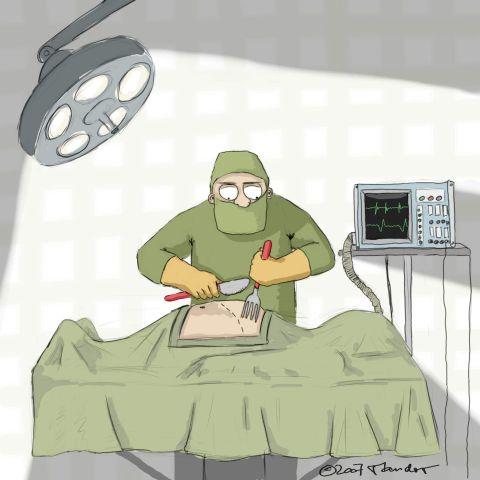
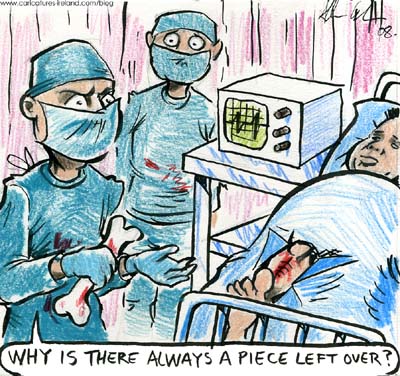
Showing posts with label surgery. Show all posts

Sunday, 13 October 2013

Luck of the Irish


Hi,


So much time between posts - time is flying at the moment! So much for my decision to do little and often, I will just have to work with what I can do I guess!

The last few weeks have been pretty hectic, some F1s were off on holiday/sick and I had to cover for them. Really not an ideal system as I already spend the day working, so I am not sure how I am meant to do two jobs at once! Fortunately I just about survived that staying a bit late and getting others to help out. As I said before, having helpful colleges makes so much difference! This week just gone I have been on call, and it is absurdly busy. The on call team consists of - F1 (me), SHO (few years more experience) Registrar (surgeon) and consultant (on for whole week, 24/7, but somehow at home all week at the same time). These 4 people (realistically two, as the consultant is at home waiting for some kind of emergency he will need to do, and the registrar in theatre doing the operations) have to see all new people who come in under surgery for that week. The start of the week was really good, as we started with no patients, as the team on call last week had taken those who had come in under their care for their normal day-to-day work. I got to spend the the first few days clerking in new patients, working out management plans and diagnoses- all very interesting and the side of medicine that I think I enjoy the most. As the week progressed, however, we ended up with dozens of patients under our care; the SHO was having to clerk in all the new patients on her own. This is any patient referred to the surgical team at all, from patients coming in through A&E with appendicitis, to patients who GPs send in due to problems they have presented with, and referrals from district nurses. Could be 10-20 people a day. I couldn't help her with this, as I was trying to sort out all of the patients who we had admitted on the ward, with all of their various problems. Very hectic, and I am glad it is over and I can go back to my day job next week.

The highlight of the last week was the mess social. The mess presidents organised for us to go to laserquest, which I won convincingly. Success! There were also a number of other bonuses over the last few weeks, including the hand over I got from the night team when I was on call which stated, in all serious "The patient was Irish, but denied any excessive alcohol intake". Sadly for the stereotype police, he had alcohol induced acute pancreatitis... 


Monday, 19 November 2012

'Killing' a patient

Hi,


It's my last week on surgery, and I am now half way through the
rotations this year until my finals! A scary thought, as I certainly
don't feel as though I am anywhere near being ready for those exams -
but still not scary enough to start revising hard, sadly... As well as
the general surgery shenanigans I have been getting up to in the
previous weeks, this week I get to spend a day on the 'simulator', an
advanced electronic dummy that simulates medical problems and lets you
practice your diagnosis and treatment skills. This is something that
was mentioned to us at the university open day about 6 years ago, and
something I have been looking forward to since then!

Regarding the things I have been up to in surgery, I have kept on
doing ward rounds and ward jobs most mornings with the junior doctor,
who is really lovely. I also helped run a pre-op clinic where patients
were seen before their operation to check on their health, take blood
tests and so on. A very formulaic clinic where the same sort of
questions were asked to each patient, so I could be very useful here.
I also spend most afternoons in theatre, to make up for all the time I
have been missing over the last few weeks. Going to the theatre should
involve some acting talent or a lovely musical, but sadly in these
cases it involved cutting out gall bladders and a complicated
operation for pancreatitis where the necrotic 'rotten' pancreas was
removed by punching a hole all the way the stomach from the front,
using keyhole surgery, and draining out all the pus and dead tissue.
Watching the difference between the consultant and the registrar
operating was very interesting, as the difference in experience does
show. Both clearly perform safe and effective surgeries, only the
consultant does so much more quickly, and the movements he makes seem
a lot more confident and meaningful. It is almost beautiful to watch,
but I still don't want to be a surgeon and have to do that every day!

Onto the simulation training. As I said before, this was something I
have been looking forward to for ages. Imagine getting your 'own'
patient to try and diagnose and treat - its like being a real doctor
but with none of the responsibility if things go wrong. The mechanical
patient had a rising chest, pulses, heart sounds and opening moving
eyes, as well as veins which can be cannulated and lots more, meaning
loads of different diseases can be simulated, diagnosed and treated.

The way our session worked was there were four of us, and we were put
into two pairs. The idea was that one person would 'lead' a case,
while their partner assisted by doing things they asked them to do,
such as prescribing drugs and carrying out procedures such as taking
blood. In each scenario there was a trained nurse who would assist in
doing things a nurse would do, such as giving oxygen and administering
drugs prescribed. While all this was going on, the other two sat in a
different room, hidden by a one/two way mirror (why are these words
the same thing!), and watched what was going on to give feedback at
the end. The case I got was severe abdominal pain after binge drinking
in Ibiza, which I diagnosed as acute pancreatitis, (fortunate as I had
written an essay on this a week ago), initially giving fluids and
oxygen, then calling for a senior opinion. I did forget to do an ABG,
but other than that it all went very smoothly, though the 10-15
minutes the case took flew by in a whirl of activity. The excitement of
it, and how you get immersed in treating this very sick patient felt
quite real, and it makes me want to do acute medicine even more!

The case that I was there to assist my partner for did not go so
smoothly... This was a patient who had a severe respiratory infection
on top of a history of heavy smoking. She ordered all the correct
investigations and initial stabilisation of the patient was successful.
By this point we had both noticed that the patient was allergic to
penicillin, she by the wrist band on the patient and myself by
flicking through the 'admission notes'. Despite this, when working out
the CURB-65 score (a score used to see how severe pneumonia is), she
used the result to prescribe co-amoxiclav, which was an appropriate
antibiotic to give the patient. Other than the fact that they were
allergic to penicillin. Despite the fact that I knew about this
allergy, and had in fact only just written down on the drug chart that
the patient was allergic to penicillin, I went on and wrote up the
co-amoxiclav to be given, pretty much with the same pen stroke. Well,
the less said about this the better, but I can definitely say that
after making such a horrible mistake, that will stay in both of our
memories and we are very unlikely to make such a mistake again!
Despite having found out all the evidence (and knowing that we
shouldn't give co-amoxiclav, which all med students know is penicillin
based) we didn't link the two and gave it anyway. We were very lucky
it was only a dummy - but it does show how easy it is to make mistakes
in medicine, and the dire consequences that can come about if mistakes are made...

Monday, 5 November 2012

There is no such thing as a free lunch


Hi,


Another week in my surgical placement, and I finally learn that I am on an 'upper GI' surgery placement. Still not 100% sure this is the team I am meant to be with, but they are really friendly so I think I will stay here. Should be a pretty similar experience to wherever else I end up put, as long as the signature at the end counts towards passing this year!

Its a very busy week, I tend to need to get in at 8, and leave between 6 and 7.30, and with 30 mins- 1 hour travel time each way, I can end up away from home about 13 1/2 hours a day. Doing this five days a week means I am effectively working 60-67 hours a week. For free. Rubbish! Leads to me feeling pretty tired when I get home, so I eat dinner and don't want to work, not good for the revision I am meant to be doing.

I spend much of my time in the wards, this is our 'post-take' week, meaning the floods of patients we admitted last week, we are now trying to get rid of, treat, or ignore. I can be very helpful as a lot of this involves no skill, but just chasing up results and updating lists. I do spend some time in surgery, scrubbing up and 'assisting' in a number of hernia repairs. While 'Assisting' sounds really important, it (as expected) just involves holding a retractor or pushing bowel around every so often. I don't think surgery is the career for me...


Its all the same thing...


In more positive news, the lovely man who I clerked last week, who ended up being rejected by the urology registrar for catheterisation and bled out of his penis for hours as a result and needed a suprapubic catheter is doing very well. I have been visiting him every day, and not entirely because I am very guilty about the mess the hospital has got him into. He is really nice and a fun chat for five minutes when I am waiting around. He told me that once he is out of the hospital he wants to buy be a few pints, a really nice offer, but I am not sure if I can be encouraging alcohol consumption (or even socialising with patients) so I politely decline. This is the great aspect of the job. Cutting people up and sticking your hands in their wounds in boring and nasty, its the personal aspect I love.

Being a surgeon is not all cutting, though. I am invited to a posh (and more importantly free) dinner part way through this week to 'discuss a certain surgical technique'. This fully funded sojourn (by an unknown, shady organisation that wasn't mentioned) involved a fifteen minute talk on this surgical technique at a hotel (surprisingly interesting), which was followed by an hours talk by an Olympic medallist (I have no idea why), about their experience of the olympic games. Very interesting. There was then a three course free meal with wine. Very classy! It did lead to me getting home at 11 this day, though, making it feel as though I spend my life in the hospital, but it doesn't seem as though other specialities have quite as many 'Jollies' as the surgeons. They always seem to be having important 'talks' which happen to be in posh hotels, or the Bahamas. Perhaps it is to make up for the fact that their job involves cutting up bowels, sticking their hands in poo, and never getting thanked as their patients are always asleep...

Monday, 29 October 2012

Change to surgery


Hi,


I change rotation this week, and location. I am now back living in my 'own' rented house with my flat mates, rather than the hospital accommodation I have been in for the last 8 weeks, and commuting an hour or so drive to another District General Hospital (DGH) every day. Living back with my friends is lovely, though there are bad aspects too. An hours commute rather than 2 minute walk means really early mornings, and the fact I am now living with my friends, and back in a city where I know lots of people, means that I am not spending much more time socially, and a lot less time doing any work. In summary, the move is good for me, though not good for my work or sleep. 

The new rotation I am on is surgery. This week our team was on take, meaning all surgical patients who came into the hospital (a surprisingly large number) came in under our team, meaning we needed to sort them out and either treat them, or somehow palm them off on a different speciality. Palming people off can be easy (if they have a fracture, orthopaedics love it) but is usually very complex, as many people get stuck in hospital for social or 'unknown' reasons, meaning they cannot be transferred to another ward. While being on take was really interesting for me, and meant I got to do a lot of history taking and so on, it also means I have spent no time in theatre yet, and actually still don't know what speciality within surgery I am placed on.


I was told I was being placed in breast surgery, but one of the junior doctors tells me that that the consultant I have attached myself to is an 'upper GI' surgeon. He spends all his time working away from the ward, and I have seen him for 2-3 minutes this whole week, so I have no idea. It is possible that I have spent a week with the wrong team, but its all learning I suppose!

It was a good week as well. Clerking patients in when they first get to hospital is something that I really enjoy doing. It needs a lot of brain power to work out which questions to ask to exclude the serious causes / cover the common possibilities, then use your information to decide which causes are most likely, and then order investigations (such as blood tests and X-rays) to prove or disprove your 'differential diagnoses', while excluding serious problems (like heart attacks). I really enjoy having to think like this, and it is much better practice for my finals than doing paperwork. I think working in A&E or an acute speciality where this is the norm would be something I would really enjoy.

This week I got to go through this routine with a number of different people, being the first person to see them, taking a history and examination, deciding what bloods to investigate, inserting a cannula to take the bloods and give fluids, taking them to the ward and deciding on the initial management. It was often hours and hours between when I saw them and the first time a doctor saw them, so making the right decisions is very important (or at least not missing something really serious such as a heart attack, or ischemic bowel!) Pretty stressful, but so rewarding.

One of these patients was in acute retention, meaning he hadn't urinated in 4 days. I requested an ultrasound bladder scan to see how much urine he had, and decided that he needed to be catheterised relatively soon, as he had a good few litres in there (as would you if you didn't go to the toilet for 4 days!). I took bloods (looking at kidney function, as this pressure may be damaging them) and decided to call the urology specialist in the hospital to help insert a catheter to relieve the pressure in the bladder. He had had previous surgery to the prostate, and had a stricture - normally catheterising himself but finding it impossible to insert over the last 4 days (hence the massive bladder). I thought that, if he cannot do it, despite having 5 years experience, there is no chance I will be able to! The urologist clearly didn't think so and SHOUTED down the phone at me for a good five minutes about how useless I was, how I was worthless and how dare I waste her time... Completely unnecessary, and time which could have been used catheterising my patient. Instead I had to ask my senior to do it for me, who was just a general surgeon. This went badly, and ended up with continuous bleeding from the penis, and a needle having to be pushed through the abdomen straight into the bladder to relieve the pressure (called a suprapubic catheterisation). It would be a good case for a 'told you so' to the urologist, if I wasn't so scared of her... Fortunately the patient was OK, and was very understanding and lovely about the whole thing. It always seems to be the lovely patients who end up with the raw deal... Since admission I have been to visit him every day, and he always gives me some grapes to eat (reason enough to visit!) and he is recovering well, with surgery planned for the Monday!

Catheterisation on the left, to get urine out of the bladder, and suprapubic catheterisation on the right, bypassing the penis and just putting a tube right through the belly into the bladder.
 
UA-12501063-1