Showing posts with label ophthalmology. Show all posts

Monday, 2 April 2012

Patients


Hi,


A lot of the time in blogs, I talk about what I did (or didn't do), about what the hospital is like, and what I saw. Basically, a lot about me. Now, while I may enjoy talking about myself, this probably isn't why people read this blog, and it isn't really the most important (or interesting) thing in medicine. What takes this title probably varies between different people, but in my opinion it is the patients. While the diseases they present with can often be the same (with respect to their pathological cause), their stories about their lives, how they cope with their illness and everything else are invariably different and interesting. This week I will talk about some of the patients I saw in my last week on ophthalmology and at the GPs (in an anonymised way, of course, to prevent recognition...) from the morphine-dealing-mum to the side effects of Jonathan Ross


The ophthalmology clinic started with a wonderfully cheery looking Russian lady who had come in with a punctured eye. Worried about the risk of infection, the doctor wanted to find out how this had happened so as to get the best treatment. Despite all of his (and my) best efforts, we just had no idea what this lady was saying. It wasn't because of a language barrier as (I think) she spoke near perfect English. It was more that her accent was so thick it was unintelligible. The consultation meandered on for about five minutes with us absolutely unable to understand her, while she seemed to understand us perfectly. In retrospect, we probably should have communicated by writing things down, but embarrassed to admit that he couldn't understand what she was saying, the doctor just told her that he needed another opinion, sending her to one of the other specialists in the hope they would have more luck... Talk about passing the buck!


The next patient who came in talked English in a perfectly understandable accent, and on examination with the slit lamp, the ophthalmologist diagnosed him with a vitreous haemorrhage (basically a bleed in the eye). The ophthalmologist had left the room to collect a part of the notes, so I was talking to the patient about how this had happened. He works as a painter, and was having a night in, with some pizza and TV. He was watching reruns of 'Friday Night with Jonathan Ross' when he suddenly started getting floaters in his vision, along with loss of vision. My verdict? Jonathan Ross makes your eyes bleed...
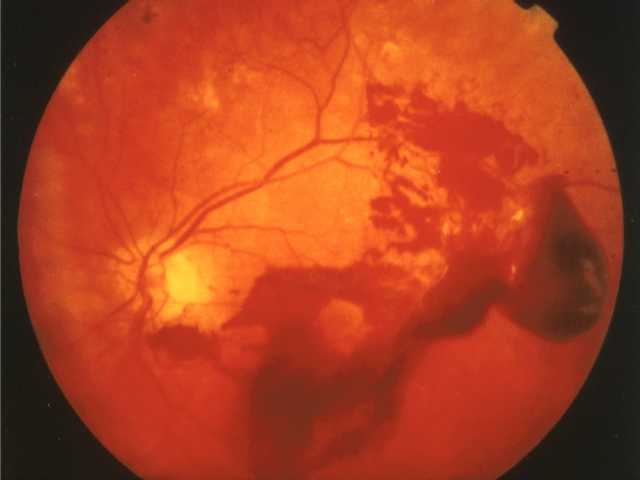

A picture of the back of the eye (the retina) after a vitreous haemorrhage 


A later patient, coming back after a year for a follow up appointment, on entering the consulting room proclaimed proudly to the ophthalmologist "you have lost weight". The ophthalmologist, a somewhat business like doctor, just replied that he hadn't and was the same. This lead to minutes of discussion where the patient tried to convince the doctor he was losing weight, while the doctor tried to start the consultation, but kept denying his weight loss. It would have been a lot easier to just accept it and move on! Later in the same consultation, after receiving the iris-widening eye drops that are used to look into the eye more easily, the 30 year old patient asked if he could buy some from the doctor, as it would make him look 'pretty cool' at raves, and could be useful for attracting ladies in coffee shops (after all, everyone knows big wide pupils are attractive). I told him that the drops made the vision blurry, so he may end up chatting up a coffee machine, which earned me a laugh from the patient and a scolding from the ophthalmologist...


There were many other patients worth mentioning, such as the patient who had seen a vitrectomy on youtube (such as the one below) and wanted one for himself, despite having no symptoms, but I could go on all day. A moment of self-indulgence means I want to say that I can now do ophthalmoscopy properly now, after just pretending I could for some time. The ophthalmologist was kind enough to get me to do it on each patient and tell him what I saw. By the end I managed to spot hard exudate in one patent, and microaneurysms in another, diagnosing diabetic background retinopathy in both. A successful clinic!


vitrectomy, where the jelly inside the eye is removed. Apart form the start, it is surprisingly squeamish-friendly! 


My time with the GP was equally interesting on the patient front. There was the vegetarian (macrocytic) anaemic 90 year old who the GP wanted to give B12 shots to help combat the anaemia, but who was petrified of needles. I recommended Marmite to her, and promised it would be a more pleasurable alternative (somehow she hasn't heard of it...) I just hope she doesn't hate it and wish she had taken the injections! Other patients I saw with the GP included the woman who had broken her arm in the USA and been sent back with some kind of cyborg-like-exoskeleton over it which no-one in the practice seemed to have seen before. The supporting documents she had been given were very sparse, and the DVD she also had wouldn't work on the computers. Very futuristic, but somewhat impractical when no-one knows what to do with it! There was also a mother who had just had a new child at 50 years old, and was struggling to cope with it, after her husband had left her. She admitted that the oramorph (morphine) the GP had given her for unrelated pain had all gone, as she had had a party and shared it with her friends for a 'high', and said she needed more. Not really the responsible behaviour of a new mother, or of a 50 year old lady...


Basically, the patients make medicine. The reason I enjoy clinics so much at the moment is because of the wonderful (and sometimes absurd) things you hear from your patients. Later, as I learn more, I am sure that I will enjoy the process of diagnosis and management of disease as well (not something I can do at the moment), but I hope that I don't lose the enjoyment from hearing about peoples lives. If I can get paid to do this for my whole life, I am going to be a very happy optimist! 

Tuesday, 27 March 2012

Procrastination


Hi,


Still on ophthalmology, and seeing some interesting cases, but a lot of my time is really taken up with essays and other boring stuff. Apart from these essays, ophthalmology (perhaps if I write it enough times I will learn to spell it properly) seems to be dominated by a few, common conditions. It seems the same with most specialities: endocrinologists see a lot of diabetes; A&E doctors see a lot of alcohol based problems; and ophthalmologists see a lot of glaucoma and squint patients. The glaucoma patients tend to be older while the squint patients tend to be children who need to have their squint corrected before their brain 'turns off' one eye to stop the double-images that squint produces, losing them vision in that one eye (amblyopia).


Squint is called strabismus, and the clever brain turns one eye off to get rid of the double image it creates. This means that if it doesn't get treated quickly (for instance by patching the healthy eye to force the 'lazy' eye to work properly) the eye may not work properly, something that will stick with you for the rest of your life and is untreatable as it is a neurological condition

Firstly, though, I would like to apologise for my poor time keeping with uploading these posts. I was initially trying to do it every Sunday, which then became Mondays as my Mondays became busy, and today it appears it is Tuesday. This is partly because I am busy with other work, partly because I am not sure what to write about and (largely) partly because I am a chronic procrastinator and seem to be very efficient at putting things off... I do have a number of essays and the such due in which I do keep trying to do, but somehow keep avoiding actually doing, and this committed procrastination is very time consuming. As this year is a lot more laid back than my 3rd year, or intercalated year, I am also enjoying having a social life before it disappears up the chimney with my final year and final exams next year.


Enough excuses, though. This week I spent time in surgery, outpatients clinics and eye accident emergency. The theatre session was very similar to last week, seeing cataract replacements and retinal detachments repaired. While very same-y surgery, the nurses and doctors were really lovely to us medical students, and made the experience really enjoyable. Just having friendly staff who are nice to us (not as common as you might think, we are the bottom of the hospital hierarchy and do just get in everyone's way) and interested in teaching make such a big difference to whatever placement you are on.


The outpatients and accident and emergency are surprisingly similar. The outpatients runs like any other hospital outpatients service, arranging follow up appointments for patients with chronic diseases such as glaucoma or taking referrals from GPs who want a specialist opinion. Here there are a lot of squints and glaucoma patients. Both diseases that can be easily controlled and treated, so quite a positive speciality in that respect. The eye emergency department is very similar to the outpatients, carried out in a similar location and just not needing appointments, people turn up when they have problems with their eyes and are seen as soon as possible. Here, patients with foreign objects stuck in their eyes, rapid changes in vision and so on are seen and examined. I was really surprised by the number of patients who seemed to get metal shards embedded into their eye ball, and needed to have them removed. I suppose metal is sharp and sticks into skin easily, and if you have burrs on your hands and wipe your eyes they may get stuck in. The problem with metal in the eye is it can create a 'rust ring' around the shard, meaning that the patient has to come back for a follow up, strangely also carried out in the emergency department making it almost like a clinic.


A picture from a journal of a rust ring, left after the metal object has been removed

Monday, 19 March 2012

Eye surgery


Hi,


New rotation and a new start this week. Finally leaving dermatology and its sparse timetables behind (though I am not going to lie, I am going to miss all those gaps) and moving onto ophthalmology; medicine of the eyes. Looking at the timetable on Monday, I could see that it was going to be a lot more hands on than dermatology, with clinics and tutorials in the mornings and afternoons of all days! Its going to be like my third year again, I hope I am not too old for all that work...


My favourite part of this week was getting involved in some eye surgery. When I say 'getting involved' I really mean watching some... It is very intricate surgery, and I think that letting a medical student try and assist would be a terrible idea. I saw several cataract removals, and a few retinas be reattached. Cataracts are where the lens becomes fogged in the eye, so you cannot see very well - the surgery involves removing the lens and replacing it with a plastic one, which is clear. Seeing as cataracts are one of the most common surgeries done by the NHS, and the most common cause of reversible blindness in the UK, this is quite an important operation. It is done by making a cut in the eye in the white of the eye, and working through this cut to 'suck out' the old lens after mincing it up, and then a new one is injected in through the same hole. This way there is minimal cuts made in the eye, and only the front of the eye is affected. It takes 15-30 minutes, which I thought was pretty impressive for surgery which involves sticking things in the eye. I was afraid it would deflate, a bit like a tire with a puncture when the holes were made. I am very glad it didn't!


The other operation is where the retina, the layer of cells on the back of the eye, starts peeling off the back of the eye (detaching) due to small holes in it letting fluid get behind it. This operation is similar to the cataract one, in that it is done down a microscope-like-machine with tiny instruments, but as the back of the eye needs to be operated on (rather than the lens which in the front). This meant a number of tiny tubes were put into the eye around the iris (coloured bit) and instruments were put down the tubes to seal the retina back onto the eye (keyhole surgery). Again, I did secretly expect the eye to deflate a bit, but I wasn't going to mention this to the ophthalmologist and get laughed at!


One of the patients who was having the operation had a female name, and long hair and jewellery but the notes said male and they did look distinctly male with a touch of shadow under their chin. This lead to a fun talk from the anaesthetist first, while the local anaesthetic was being put in the eye to numb the pain before the operation started. The anaesthetist kept talking herself into corners while chatting to the patient and us, saying things such as "when this young .... .... patient goes into theatre" and so on, with slightly awkward pauses as she was unsure whether to say man or woman... I was always taught you should refer to them by their chosen gender, but when unsure, best to avoid the topic all together! Fortunately I don't think the patient noticed the pauses (its likely they were more worried about the fact someone was going to stick knives and tubes into their eye in the next 30 minutes). As this patient only had a local anaesthetic to the front of their eye, I was curious as to what they had seen during the operation. The patient said that it was like a kaleidoscope of colours throughout the operation, and as they couldn't feel anything, not an unpleasant sensation at all!


Going in for an eye operation? You will get a trippy display to keep you occupied while they do what needs doing!


One of the other patients coming in for surgery had specifically requested to have a general anaesthesia for the eye surgery, as he hated the idea of people touching his eyes, let alone operating on them. After a long discussion the anaesthetist had agreed to it, and after putting him to sleep, the anaesthetist was teaching me and the other medical student there how to manually breath for someone with a bag-valve-mask (in the name, its a bag stuck to a mask with a valve between). It looks very simple - stick the mask over their nose and mouth and squeeze the bag, but it is a lot more complex to actually get the bag to seal over the face while keeping their airway open. The head needs to be tilted backwards, while keeping the seal with one hand, leaving the other hand available to breath. While I was making my poor attempt at this manoeuvre (and failing) the anaesthetist tried to help instruct me and move my hands to the right location. It was hard a manoeuvre in itself, but the fact that while I wasn't doing it, the patient wasn't breathing was pretty frightening... While I am well aware that the anaesthetist could have stepped in any time before it got dangerous, the fact the patient had been lying there for a minute, while the machine bleeped urgently at me really didn't help me try to concentrate on tipping the patient's head back just right.... I did manage to get it in the end, so no deaths to my name yet, fortunately, though after that shocking performance perhaps emergency medicine is not for me!


Despite all this talk about surgery, it was only a small part of my week. I also did clinics where I found out how little I know about eyes and eye disease, and spent some time in a huge warehouse trying to hunt down stored patient notes to help me in a research project that I need to do. This time was not well spent, as I found none of the notes I was looking for at all, but the sheer magnitude of the number of the notes was huge. Just thinking that each of these files was a person, and all of the sheets of paper in them were filled with their suffering was... indescribable. I am not sure I have seen a place which really sums up what a huge amount of work the hospital does in such an effective way before, but it was almost like some kind of cathedral or church to all the suffering from all of these people; waiting to be pulled from the shelves for the next attendance to the hospital... 
 
UA-12501063-1