Hi,
This was a pretty exciting week, and not just compared to the pretty humdrum weeks that have passed by recently. This week I spend an evening with the trauma and orthopaedic team on call, followed by a day carrying out the following ward round and surgeries. While other things did happen this week, this was by far the most exciting, which helps confirm that I want to go into some sort of emergency/acute medicine as a career. While I don't enjoy the orthopaedic (or any) surgeries, they seem routine and boring, having to deal with real medical emergencies right there right now is very exciting. I would love to do that later (hoping I have the knowledge), but i get ahead of myself. I will say a little about what the on call was like and why it was so much fun.
The on call, as a medical student, involves going to the hospital mid afternoon and attaching yourself to one of the orthopaedic team until (in my case) about 11PM. Most of the time we have spent in the hospital this year has been in clinics and during the day, so getting back onto the 'hospital floor' as it were, and working at a more unusual time is an exciting thought in itself. After arriving I attach to a registrar, along with my medical student colleague, who works mainly with fractured hips. She is a really friendly, fun, and helpful doctor which makes the evening fly away.
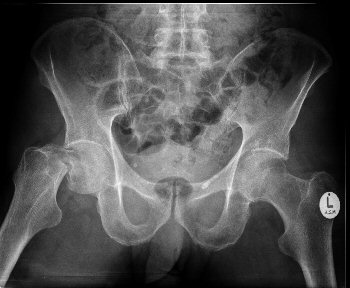
We spend a lot of the time in the A&E department, and as she is the surgical on call, we also go to wards where patients are reported by the nurses as getting sicker, or needing a review, to see how they are. In the emergency department we see 3-4 fractured hips, all of them are in elderly people who have fallen (either through a trip or through a medical condition such as a heart problem) and broken the top part of their femur where the lump makes it into a ball to join into the hip. These are called 'fractured neck of femur', abbreviated to #NOF (as orthopaedic people live abbreviations) and need surgery the next day to replace the head, before it starts dying and you lose the use of your hip. These patients are usually in a lot of pain, and need to have their medical conditions controlled fast in order to operate on them the next day, for example reversing warfarin therapy (for AF) by using vitamin K, so the patient doesn't bleed out during the surgery the next day.

The right of the image (labeled L for patient's left) is a normal hip, whereas the opposite side is a displaced [moved out of position] fractured neck of femur
We soon found out that these patients were the tame side of the on call, as we were called to a polytrauma patient, who had crashed and rolled his truck, and become stuck inside for some time before getting to the hospital. Various specialists are summoned to the emergency department by their bleeps, such as anaesthetists to help stabilise the patient's airway, which goes off when the ambulance lets the hospital know that it is bringing in a trauma patient. The buzz in the air as these people collected, putting on their lead gowns to protect from the portable X-ray machine used to look for breaks and the like, was very exciting. Once the patient arrived, strapped to a stretcher with blood smeared limbs visible in the folds (just like in a TV show) the atmosphere calmed down from that excited buzz to a calm businesslike feel. There are about 10 people or so around the bed, each having jobs to do, with a leader at the foot end commanding people and assessing the overall status of the patient. The anaesthetists work at the head end, while other doctors put in cannulas to give fluids or blood, and others perform a head to toe survey to look for injuries. Scans are taken and it is decided that the patient needs a CT because of a large injury to their head, and they are quickly taken off. All very exciting, and amazingly organised. I would love to be part of that sort of team one day, working together to save someone who is critically ill.
It wasn't just surgical cases that I saw while on call though, as when we were called up to the wards for patients who had problems, these problems were usually medical. For example, one patient who was in a few weeks after a knee replacement (waiting for nursing home) was reported as acting 'weirdly', and after we got there and tried to talk with her for 10 minutes (hard to communicate with) she started having a seizure in front of us. There was just this one doctor and the ward nurse around to try and work out why this was happening, and control the seizure (a very scary thought that that would be me some day. I need to learn so much more first!). The seizure proved difficult to control, and due to some other circumstances a 'medical emergency' call had to be put out which, similar to the trauma call, had a good variety of different medical personnel arrive in minutes to help with the situation. All very exciting, and the patient's seizure was stopped, though they think that she had something like pneumonia or a PE which had lead to this. Both consequences of staying in hospital for too long, a shame that she couldn't just go back to her nursing home.
All in all, a really exciting week, with the on call being full of the reasons that I want to be a doctor. Unfortunately I also talked a little to the doctors about their hours. This came up because I saw that, when I left the hospital at 11PM there were a few doctors who were set to stay on all night, who seemed pretty busy. When I arrived the next morning for the ward round, they were still there, went on the ward round then started their operating lists (being surgeons). This seems crazy - do they have time to sleep? While in a clinic for people with fractured bones, I asked one of the registrars about this, and she told me that she has worked 117 hours this week. That leaves 51 hours of the week left, or about 7 hours a day not in work (assuming she works the same amount each day). That is a hell of a lot of work. While nights give the 'chance' to sleep, realistically very little sleep happens because of all of the admissions and care that people need. A scary prospect for a medical student, where finals seem like the biggest challenge on the horizon. She was less upset about it than I would have thought, though she did admit that it made her grumpy, and she was upset that she only got paid for a fraction of the hours she did, die to the European Working Directive (48 hours max a week)...



 Posts
Posts

